Saturday, March 29, 2008

El Chino By: Allen Say


Summary: This is a true story of an Arizona-born Billy Wong who was the first-ever Chinese bullfighter. As Billy grows up, his father tells him, over and over again, "In America you can be anything you want to be.'' Billy retains his fathers advice as he visits Spain and faces one seemingly insurmountable obstacle after another on his triumphant way to the bull fighting ring. While striving to become a bull fighter he is held back by his appearance when he is often informed that "Only the Spaniards can become true matadors." So he stayed in Spain and went to bullfighting school, but after two years passed without fighting a single cow, Billy realized that a Chinese matador might stand out in the crowd of aspiring bullfighters--as indeed he did. After his first success as El Chino --The Chinese--in his native costume, Billy received an offer to become a real matador. Say's text renders Billy's complex story with simplicity and grace, and provides inspiration in presenting Billy as an endearing, determined hero.

Reflections: This story was great because it gave perspective into the life experiences of a first generation Chinese immigrant. The idea taught to Billy by his father of having the ability to be anything you want to be in America, is a similar idea that immigrants from many diverse share. The main character, Billy, was at first held back from his goal of becoming a matador because the Spaniards doubted his abilities based upon his appearance. However, this book teaches the reader that by persevering and embracing your true heritage will help you in accomplishing what you want to be.

How this book can be used: The author Allen Say has written several books that all revolve around the same theme of Asian immigration to America. His various books provide multiple perspectives on the process and experience of immigrants. Since there is a similar theme throughout his stories, this book would be good for an author study. This story can also benefit a unit on immigration because it depicts the effects of immigration on people throughout their lives and into adulthood. I would also use this book to focus on the lesson of the story which is to strive for anything you want while still embracing your cultural backgrounds. The main character was only acknowledged after he showed his true identity which made him stand out among the rest of the people. This book can encourage students to take pride and share the traditions of their culture because it is that part of their identity that makes them a unique individual.

Domains of Social Justice: 1) First generation Chinese immigrants may relate to similar struggles that faced the main character. Chinese students may learn about traditional clothing of the Chinese culture. 2) Students learn about one immigrants experience and can relate that to their own immigration experiences or those of their relatives. Students might relate to similar harships that they or their family have experiences when immigrating. 3) Students explore issues of streotyping and prejudices and how these issues held back the main character from achieving his goal. 4) Students learn from the obstacles and struggles this main character faced. Students discover ways to change negative perceptions other people make by maintaining determination and embracing ones own cultural heritage.

Monday, March 24, 2008

Hey, Little Ant- Mark Coccarelli

Hey, Little Ant
Hey, Little Ant
By Hannah and Hoose


Link to where you can purchase book:http://shop.scholastic.com/webapp/wcs/stores/servlet/ProductDisplay?productId=18839&langId=-1&storeId=10001&catalogId=10004


Summary: PreSchool-Grade 2-Based on a song, this occasionally stilted narrative has a message: respect all creatures and their right to live. A bespectacled ant, loaded down with two shopping bags, is confronted by a human youngster intent on stepping on him. Before the boy can carry out his threat, the ant begs him to reconsider. Each double-page spread is devoted to one character expressing his opinion in the life vs. death debate. The brightly colored, full-page cartoon illustrations, rendered in pen, ink, and watercolor, capably convey the obvious differences and the surprising similarities of the two main characters. The boy is urged to look at things from the ant's point of view before deciding on his course of action. The tale's conclusion is open-ended as readers are asked, "What do you think that kid should do?" The accompanying picture shows a huge sneaker posed above the tiny ant. The music and verses appear on the last page of this tepid tale that could lead to discussions concerning bullies and/or the protection of other species.

Reflection: This is a really good story that shows how to look at things from a different perspective. It shows how a giant person and little ant have more in common then from looks on the outside. The book is also open ended and it allows the children reading the book to take part in the story and decide based off what they have learned in the story weather of not the boy should crush the ant

Websites:

http://www.heylittleant.com/educators.html

Domain of Social Justice Education:2.) Respect for Others- Strengthens intercultural competence. The boy looks at life from a different perspective. Sees that the ant’s life is very similar to his own.
3.) Exploring Issues of Social Justice- Racism, Classism, Sexism, homophobia and other forms of oppression are confronted. The boy looks at things from a different perspective. He used to make judgments based off appearance. He thought because the ant was tiny and small he wasn’t like the boy at all.

Thursday, March 13, 2008

It's Okay to Be Different


Summary: It’s Okay to Be Different by Todd Parr is a fun-loving story about the many differences that exist between all people and a unique way in which we can embrace and celebrate those differences. Even though this text may appear to be silly and simple, it’s bright, bold colors and powerful words carry a strong message. The appearance of this text draws students in and the messages of understanding, acceptance, and confidence in oneself keeps them entranced from beginning to end. Combating issues of racism, ableism, perceptions of beauty, immigration, homophobia, adoption, and more this is an important text for all children to be exposed to.

Reflections: It’s Okay to Be Different by Todd Parr is a wonderful story filled with eye-catching illustrations and meaningful narration. I really enjoyed reading this book and each time I read it to children I saw just how much they enjoyed it too! Although this book looks very simple at first glance, it displays issues in today’s world that are relevant to students and need to be discussed. As I read the book for the first time I felt that the way in which Todd Parr discussed heavy issues such as racism, ableism, perceptions of beauty, immigration, homophobia, adoption, etc. was brilliant and appropriate for young readers. Written in a simple and repetitive manner, this book states many ways in which all people are different and repeatedly asserts that these differences are “okay.” Even though there is no mention of the terms racism, ableism, perceptions of beauty, immigration, homophobia, adoption, etc. the issues are there and it is up to the person reading the book how much depth and detail they will discuss based on issues that the book presents. Finally, I think it is great that this book discusses more than one issue because the fact is that there are many issues of social justice and children need to learn about all of them not just racism.

How I would use this book/curricular units: This text would be great to use when introducing students to the terms of racism, ableism, perceptions of beauty, immigration, homophobia, adoption, etc. In addition to introducing these terms, this book could be used to discuss what each terms definition is, what they mean to the students, and how Todd Parr portrays their meaning in his book. In concordance with this, students can discuss whether or not racism, ableism, perceptions of beauty, immigration, homophobia, adoption, etc. exist in their lives and the role that they play in their lives. The teacher can ask students to not only share the factual information regarding their experiences but how those experiences made them feel and what they would have done to change the situation if they could. The teacher can also have the students create a role-play that they will perform in front of the class in which they act out a scenario demonstrating the meaning of one of these terms and the effects that these terms have on others. Then, the students can talk about what should have been done differently and recreate the scene showing how people can combat racism, ableism, perceptions of beauty, immigration, homophobia, adoption, etc. through their words and actions.

Elements of Social Justice Education: 1) Self-love and Acceptance: Students will learn to love themselves for who they are and where they come from. They will see themselves in the text by being able to relate to one of the many descriptions given and recognize that just as Todd Parr writes about these differences he also writes about the fact that it is okay that these differences exist thus fostering a sense of acceptance for others as well as ourselves and where we come from. 2) Respect for Others: Students will learn to investigate other people and cultures and appreciate them for what they are by looking at not hiding from what makes people and cultures different, talking about those differences, and accepting and respecting others for who they are and where they come from. 3) Exploring Issues of Social Justice: Students will discuss and learn more about racism, ableism, perceptions of beauty, immigration, homophobia, adoption, etc. and the effects that these issues have on all people. 4) Social Movements and Social Change: Students can explore the issues presented in the text and discuss how people have worked to change society using Todd Parr as an example for writing this book. In addition, they can connect social movements and social change from the outside world to their classroom and discover ways in which they could combat issues similar to those in the text. 5) Taking Social Change: Students will learn how to take action and create social change on their own by looking first at their own classroom and the existence of issues like bullying and its underlying themes to take action against issues such as ableism, racism, classism, perceptions of beauty, etc.

Links:
 http://search.barnesandnoble.com/Its-Okay-to-Be-Different/Todd-Parr/e/9780316666039/?itm=1
 http://www.amazon.com/Its-Okay-Different-Todd-Parr/dp/0316155624/ref=pd_bbs_1?ie=UTF8&s=books&qid=1205271920&sr=1-1
 http://www.smarter.com/childrens-people-place-books/its-okay-to-be-different/pd--ch-1--pi-899810.html
 http://www.target.com/dp/0316155624/sr=1-1/qid=1205272199/ref=sr_1_1/601-4792414-1228933?ie=UTF8&index=target&rh=k%3A%20It%27s%20Okay%20to%20Be%20Different%20&page=1

Tuesday, March 11, 2008

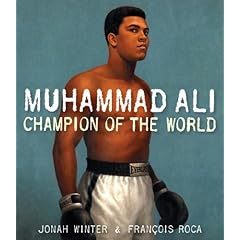
Muhammad Ali Champion of the World


Book Club 2: Muhammad Ali Champion of the World
by Jonah Winter and Francois Roca
Review by Akiko Nagamine

Summary:
Muhammad Ali Champion of the World is a picture book about Ali’s professional boxing career. It is written with a poetic feel, possibly alluding to Ali’s style of speech. It quotes some of Ali’s famous sayings, and uses a unique font to convey a strong message about determination and believing in yourself. The book highlights moments of Muhammad Ali’s professional career, from when he changes his name to when he refuses to fight in the Vietnam War. The book ends with the infamous “Rumble in the Jungle” where Ali defeats George Foreman in Africa.

Reflections:
I chose this book because I wanted to expose my students to a famous African-American who is overlooked in the social studies curriculum. I thought that my students would be interested in hearing Ali’s story because he is a famous person who is not discussed in schools; he is an icon of determination and strength, and some of my students were familiar with his name.

When reading this book to my students, they were extremely sensitive to the racism that was apparent during Ali’s time. Students exclaimed, “That’s racist!” and it evoked some powerful emotions.

How I used the book / Curriculum Units:
I used this book initially as a read aloud to introduce some new vocabulary words to the students. However, since the book conveys such a powerful message, I also used it for accountable talk asking students to critically discuss the major issues in the book. Students were prompted with different note cards that said things like “Muhammad Ali is (or is not) a leader because…” and “Cassius Clay changed his name to Muhammad Ali because ______________. I think that…”

This book can be used to introduce a unit on positive role models and what it means to be a role model in a community. In addition, this book may follow a slavery unit where it can be used to talk about the impact of slavery on future generations of the African-American community. Slavery affected Muhammad Ali, and students can refer to his experience to explore how slavery in this country’s past affects us today.

Portions of this text can be used in a poetry unit, especially because Muhammad Ali was famous for quoting poems to predict the outcome of his fights. He coined some famous quotes that are still used to today, such as “float like a butterfly, sting like a bee”.

Domains of Social Justice:
1. Self Love and Acceptance
– Students will learn that strong faith in themselves will help them accomplish great things. Muhammad Ali continuously believed in himself through the hardest times and was able to become the champion of the world. Students may discuss what a role model is and what it means to be a role model in today’s society.
Students may also engage in a study of Africa, exploring Ali’s strong sense of African pride and connecting that to a study of students’ ancestors.

3. Exploring Issues of Social Justice – Students will discuss aspects of racism Ali faced during his professional career. It will help put into perspective the effects of slavery on people of more recent generations.

4. Social Movements and Social Change - Students will explore Muhammad Ali not only as a boxer but an international humanitarian. He has been an advocate for the world’s hungry, and helped those in need in his home country as well. Students will continue to explore what it means to be a role model, and how they can be an advocate for change as well.

5. Taking Social Action – Continuing in Ali’s footsteps, students will choose a cause that they strongly believe in, or contribute to an organization that Ali is an advocate for. They can do something simple such as volunteering in a soup-kitchen, or contributing to the Muhammad Ali Parkinson Research Center or the Muhammad Ali Boxing Reform Act.

Sunday, March 9, 2008

Mary Braddock

Book Group # 2

Title of the Book: Private and Confidential A Story About Braille

Author: Marion Ripley

Illustrator: Colin Backhouse

Summary: Private and Confidential is a story about a young girl who longs to have a pen pal. When she finally gets one she discovers that her pen pal is visually impaired and that his sister has been reading him all the letters she writes him. The young girl initially becomes very upset about this but she then decides to learn how to write and read Braille so that her and her pen pals can keep their letters private and confidential between the two of them.

Reflections: This is a very simple story, but has an extremely powerful underlying message. The simplicity of the story is engaging though for young students and it’s not just a sappy story about someone who is visually impaired. It can bring up many discussions about a number of different issues, but it especially touches on the topic of how to treat others whom have handicaps or disabilities.

How would I use the book/curriculum units: I recently used this story as a Read Aloud in my student teaching placement in a second grade general education class. I chose it as a read aloud because it was an engaging story and it is a great way to introduce children to the subject if visual impairment. My students loved it. They were extremely attentive and engaged throughout the whole story. Wow! They were also so taken back by the idea of writing and reading in Braille that they asked if I could teach them how to read/write in Braille. Granted this is something I do not know how to do but the back of the book contains some basic to learning how to read Braille so along with my students we learned how to do some reading and writing in Braille. We also then read a book on Louis Braille the inventor of Braille which then led into a geography lesson on France.

After reading the story one of my students mentioned that their grandmother was visually impaired. Another one of my students mentioned that his grandmother was losing her vision and that she often read books on tape so he thought it would be a good idea if some how we could put our published pieces on tape and then send it to her nursing home. I was really impressed with the students’ initiative to think of ways to be more considerate of people having the same opportunities as them. The students discussed how they thought we should do something to ensure that all people are able to read out stories.

Domains of Social Justice: 1) Domains of self-love and acceptance: Students learn to love themselves for who they are. In this case Malcolm who is visually impaired teaches his pen pal that although he has a visually impairment he is still a kid like everyone else and believes he deserve to have the same opportunities to do things like having pen pals like every other kid. He teaches Laura about the cool things he knows like Braille.

2) Respect for Others: In the story the other character Laura learns to appreciate Malcom for Malcom as a person not just by his visual impairment. Students will understand that people are defined by who they are not their disability. Students will learn ways to more considerate of others needs in our everyday world.

3) Exploring Issues of Social Justice: Students can think about how they can make small changes in their everyday world to accommodate those with special needs or disabilities. Students can observe how places that should be public are not accommodating to all people

4) Social Movements and Social Change: Students can make changes in places that are not accommodating to all people or even make changes in their own classroom, school, or community.


Summary: Laura Iwasaki and her family are paying what may be their last visit to Laura's grandfather's grave. The grave is at Manzanar, where thousands of Americans of Japanese heritage were interned during World War II. Among those rounded up and taken to the internment camp were Laura's father, then a small boy, and his parents. Now Laura says goodbye to Grandfather in her own special way, with a gesture that crosses generational lines and bears witness to the patriotism that survived a shameful episode in America's history. Eve Bunting's poignant text and Chris K. Soentpiet's detailed, evocative paintings make the story of this family's visit to Manzanar, and of the memories stirred by the experience, one that will linger in readers' minds and hearts.

Reflections: While reading So Far From the Sea, I felt as though I was apart of the Iwasaki family and experiencing the journey of visiting the Manzanar War Relocation Center. I am saddened at the thought that many students go through school without learning that the United States set Japanese internment camps and not knowing the struggles this group faced as a result of the attack on Pearl Harbor. The vivid watercolors and black and white photographs provide the reader to take a closer look at the scenes of the past and recall them with an extraordinary gaze. This is a great book that exposes students to what life was like of those interned, which were also American citizens, and were deprived of their freedom.

How I would use the book/curriculum units: This book can be used to introduce students to Japanese-Americans, the internment camps, World War II, refugees, discrimination, multigenerational families, parents who have jobs and homes that were taken them away from them, parents who serve in the military. This book can be tied with those such as Baseball Saved Us by Ken Mochizuiki, The Bracelet by Yoshiko Uchida, Grandfather's Journey by Allen Say, and I Am An American by Jerry Stanley. In Social Studies, the teacher could locate Japan on the map and have a class discussion about the internment camps and studying Japanese American, Pearl Harbor, and WWII. The teacher can bring in a suitcase for display (the more older it looks the better) and have each student list what he/she would pack if he/she had to leave home suddenly -- remember they will have to carry only one suitcase and post this display on a bulletin board. Students may want to discuss or write about the significance of the Cub Scout neckerchief in the story during writing workshop.

Domains of Social Justice:
1. Self-love and acceptance- The teacher can invite a Japanese-American or a WWII veteran to talk with the class and share his or her story. The teacher can ask students if they know anyone who was interned in the camps and have them write a reflection on how this changed
2. Respect for Others-The book could serve as an introduction to Japanese culture by discovering the cultural importance of the objects left on graves--rice cakes, origami birds, cherry branches and so forth.
3. Exploring Issues of Social Justice- Students can learn about issues of racism, segregation, relocation, and freedom that Japanese were faced with.
4. Social Movements and Social Change-Students can use the web sites below to research historical background and pictures of the Japanese relocation camps. Students can build a memorial in their community for all the minority groups who died in the internment camps and will not be forgotten.
www.pbs.org/childofcamp/; members.aol.com/EARTHSUN/Manzanar.html
5. Taking Social Action-While Japanese-Americans comprised the overwhelming majority of those in the camps, thousands of Americans of German, Italian, and other European descent were also forced to relocate there. Many more were classified as "enemy aliens" and subject to increased restrictions. As of 2004, the U.S. Government has made no formal apology or reparations to those affected. The following organizations aim to exchange information on Japanese culture, community, history, social services, and public policy issues.
Japanese American Cultural and Community Center, Japanese American National Museum, Little Tokyo Service Center, Rafu Shimpo, Japanese American Network.

Internet Sites:
1. http://www.lib.utah.edu/spc/photo/9066/9066.htm (Shows photographs of what education, living, labor, and buildings were like during this time period)

2. http://www.historyonthenet.com/WW2/japan_internment_camps.htm (Provides books, DVD’s, posters on WWII Japanese Internment camps and activities teachers can use)

3. http://www.densho.org/learning/default.asp (Provides free multidisciplinary curriculum unit lessons that introduce students to questions of civil liberties in relation to the life experiences of Japanese Americans.)

4. http://www.geocities.com/Athens/8420/main.html (Lists many unread web documents that many US history texts fail to mention, a timeline of events, and photographs)

5. http://www.amazon.com/So-Far-Sea-Eve-Bunting/dp/0395720958 (Site where one can purchase the book)