Monday, March 31, 2008

Sweet Clara and the Freedom Quilt


Link to where you can buy this book: http://www.amazon.com/Sweet-Clara-Freedom-Reading-Rainbow/dp/0679874720
Summary: This is a story about an African American girl's escape from slavery on a Southern plantation. When the rigors of cotton-field labor overwhelm Clara, a kindly woman she calls Aunt Rachel trains the girl to be a seamstress in the main house. Like most slaves, Clara longs for freedom and yearns to be reunited with her mother. Becoming proficient in her sewing, she begins in her off hours to put together a map-quilt, stitching in any information she can get from overheard conversations about an escape route to Canada. 

Reflection: I think that this book is very sweet, with well developed characters and a victorious story-line but I don't think that it correctly portrays the life of a slave. All of the pictures are painted with very bright colors and it makes it seem like it was easy for slaves to escape from the south. I think that this is an appropriate book for younger students learning about slavery because it doesn't include many gruesome details and it allows you to sympathize with the characters a lot.

Book Use/Activities/Curricular Units: To help your students sympathize with the characters, you could present a concept/imagine lesson.. Each concept is paired with an imagination activity for students so the teacher reads the concept aloud to students and then offers a brief period for questions. Next, read the imagining exercise and last, allow students to share imaginings and realizations with the class.
For example:
Concept: Clara is separated from her mother before her twelfth birthday. During the times of slavery, it was quite common for the children of slaves to be taken away from their parents. Many slave children were taken away while still an infant. (This practice of separation was used to alienate slaves, deprive them of an emotional support system, and make them feel less human.)
Imagine: that when you get home from school one day, someone takes you away to a place far away from your family and tells you that you must stay at the faraway place forever. Imagine what it might feel like thinking that you will never see your family again. [Pause while students imagine. The thoughts you have may be very similar to the thoughts of Clara and many slave children of the past.]


Websites:
http://www.africanaheritage.com/sweetclara.asp
http://www.montgomeryschoolsmd.org/curriculum/socialstd/grade5/Sweet_Clara.html
http://www.sdcoe.k12.ca.us/score/sweet/sweettg.html
http://www.readwritethink.org/lessons/lesson_view.asp?id=127
Domains of Social Justice: This book offers a perfect opportunity for teachers to discuss AAVE (African American Vernacular English) with their older students. AAVE is also popularly known as Ebonics. AAVE is a distinct language variety with specific rules regarding grammar and word pronunciation. Because all of your students are either speakers of AAVE or come in contact with speakers of AAVE, it is important to affirm the idea that AAVE is not a sub-standard variation of English. Rather, AAVE is a linguistic variation that developed in specific socio-cultural conditions and is not related to one’s academic abilities. Many children that learn AAVE in their home learn Standard English as a second language once they begin school. For further reading before lecturing on this concept, you may wish to read the following web page that includes a description of the opposing opinions regarding AAVE:http://www.une.edu.au/langnet/aave.htm

Saturday, March 29, 2008

The Great Kapok Tree


Title and Author: The Great Kapok Tree: A Tale of the Amazon Rain Forest by Lynne Cherry


Link to where you can buy this book: http://www.amazon.com/Great-Kapok-Tree-Amazon-Forest/dp/0152026142/ref=pd_bbs_sr_1?ie=UTF8&s=books&qid=1206845386&sr=1-1

Summary:
The Great Kapok Tree by Lynne Cherry is a story about a man who falls asleep in the Amazon Rain Forest after trying in vain to chop down a great big Kapok tree before succumbing to fatigue and the rain forest's hot climate. While asleep, the man is visited by many of the different animals in the rain forest that rely on the tree for either food or shelter. The animals implore the man not to cut down the tree and inform him of just how important it is to everyone's, including his own, survival.

Reflection: I really liked this book. I thought it was very informative about many issues that people tend to overlook. The impact that humans can have on the rest of the world is a very important concept that children should be taught about early on. This book is a nonthreatening way to introduce the destruction and exploitation of many of the world's natural resources and the sooner children learn about it, the earlier they can start taking measures to stop it. The illustrations are beautiful and do an excellent job of capturing the beauty of the rain forest.

Book Use/Activities/Curricular Units: This book could be used for several different units. It could be used for learning about the various rain forests, habitats, ecosystems, exploitation of natural resources, etc. This book could jumpstart a discussion about what people can do to save the rain forests or other ecosystems that may be in danger of being completely destroyed. It can jumpstart a research project where students research and investigate just how living things in different ecosystems are being affected by forces of consumption and production. Students could then write their own stories or plays about other creatures telling their story and seeking to save their own. They could role play or act out their own stories in front of other classes. Afterwards, they could write letters to the companies that are causing the destruction of these ecosystems telling them of the negative impact they are having and start petitions stating that they will no longer use their products.

Websites:

http://www.sdcoe.k12.ca.us/score/kapok/kapoktg.htm

http://www.atozteacherstuff.com/pages/337.shtml

http://www.education-world.com/a_tsl/archives/03-1/lesson015.shtml


Domains of Social Justice:

Respect for Others
& Social Movements and Social Change: This book has underlying themes of respect for all living things, not just people. It highlights just how interconnected we all are and how the actions that we might take for granted, can cause someone or something else to lose everything. It stressed the pitfalls of ignorance and encourages being informed and finding out what you can do to protect the rain forest and by extension, the earth.


El Chino By: Allen Say


Summary: This is a true story of an Arizona-born Billy Wong who was the first-ever Chinese bullfighter. As Billy grows up, his father tells him, over and over again, "In America you can be anything you want to be.'' Billy retains his fathers advice as he visits Spain and faces one seemingly insurmountable obstacle after another on his triumphant way to the bull fighting ring. While striving to become a bull fighter he is held back by his appearance when he is often informed that "Only the Spaniards can become true matadors." So he stayed in Spain and went to bullfighting school, but after two years passed without fighting a single cow, Billy realized that a Chinese matador might stand out in the crowd of aspiring bullfighters--as indeed he did. After his first success as El Chino --The Chinese--in his native costume, Billy received an offer to become a real matador. Say's text renders Billy's complex story with simplicity and grace, and provides inspiration in presenting Billy as an endearing, determined hero.

Reflections: This story was great because it gave perspective into the life experiences of a first generation Chinese immigrant. The idea taught to Billy by his father of having the ability to be anything you want to be in America, is a similar idea that immigrants from many diverse share. The main character, Billy, was at first held back from his goal of becoming a matador because the Spaniards doubted his abilities based upon his appearance. However, this book teaches the reader that by persevering and embracing your true heritage will help you in accomplishing what you want to be.

How this book can be used: The author Allen Say has written several books that all revolve around the same theme of Asian immigration to America. His various books provide multiple perspectives on the process and experience of immigrants. Since there is a similar theme throughout his stories, this book would be good for an author study. This story can also benefit a unit on immigration because it depicts the effects of immigration on people throughout their lives and into adulthood. I would also use this book to focus on the lesson of the story which is to strive for anything you want while still embracing your cultural backgrounds. The main character was only acknowledged after he showed his true identity which made him stand out among the rest of the people. This book can encourage students to take pride and share the traditions of their culture because it is that part of their identity that makes them a unique individual.

Domains of Social Justice: 1) First generation Chinese immigrants may relate to similar struggles that faced the main character. Chinese students may learn about traditional clothing of the Chinese culture. 2) Students learn about one immigrants experience and can relate that to their own immigration experiences or those of their relatives. Students might relate to similar harships that they or their family have experiences when immigrating. 3) Students explore issues of streotyping and prejudices and how these issues held back the main character from achieving his goal. 4) Students learn from the obstacles and struggles this main character faced. Students discover ways to change negative perceptions other people make by maintaining determination and embracing ones own cultural heritage.

Monday, March 24, 2008

Hey, Little Ant- Mark Coccarelli

Hey, Little Ant
Hey, Little Ant
By Hannah and Hoose


Link to where you can purchase book:http://shop.scholastic.com/webapp/wcs/stores/servlet/ProductDisplay?productId=18839&langId=-1&storeId=10001&catalogId=10004


Summary: PreSchool-Grade 2-Based on a song, this occasionally stilted narrative has a message: respect all creatures and their right to live. A bespectacled ant, loaded down with two shopping bags, is confronted by a human youngster intent on stepping on him. Before the boy can carry out his threat, the ant begs him to reconsider. Each double-page spread is devoted to one character expressing his opinion in the life vs. death debate. The brightly colored, full-page cartoon illustrations, rendered in pen, ink, and watercolor, capably convey the obvious differences and the surprising similarities of the two main characters. The boy is urged to look at things from the ant's point of view before deciding on his course of action. The tale's conclusion is open-ended as readers are asked, "What do you think that kid should do?" The accompanying picture shows a huge sneaker posed above the tiny ant. The music and verses appear on the last page of this tepid tale that could lead to discussions concerning bullies and/or the protection of other species.

Reflection: This is a really good story that shows how to look at things from a different perspective. It shows how a giant person and little ant have more in common then from looks on the outside. The book is also open ended and it allows the children reading the book to take part in the story and decide based off what they have learned in the story weather of not the boy should crush the ant

Websites:

http://www.heylittleant.com/educators.html

Domain of Social Justice Education:2.) Respect for Others- Strengthens intercultural competence. The boy looks at life from a different perspective. Sees that the ant’s life is very similar to his own.
3.) Exploring Issues of Social Justice- Racism, Classism, Sexism, homophobia and other forms of oppression are confronted. The boy looks at things from a different perspective. He used to make judgments based off appearance. He thought because the ant was tiny and small he wasn’t like the boy at all.

Thursday, March 13, 2008

It's Okay to Be Different


Summary: It’s Okay to Be Different by Todd Parr is a fun-loving story about the many differences that exist between all people and a unique way in which we can embrace and celebrate those differences. Even though this text may appear to be silly and simple, it’s bright, bold colors and powerful words carry a strong message. The appearance of this text draws students in and the messages of understanding, acceptance, and confidence in oneself keeps them entranced from beginning to end. Combating issues of racism, ableism, perceptions of beauty, immigration, homophobia, adoption, and more this is an important text for all children to be exposed to.

Reflections: It’s Okay to Be Different by Todd Parr is a wonderful story filled with eye-catching illustrations and meaningful narration. I really enjoyed reading this book and each time I read it to children I saw just how much they enjoyed it too! Although this book looks very simple at first glance, it displays issues in today’s world that are relevant to students and need to be discussed. As I read the book for the first time I felt that the way in which Todd Parr discussed heavy issues such as racism, ableism, perceptions of beauty, immigration, homophobia, adoption, etc. was brilliant and appropriate for young readers. Written in a simple and repetitive manner, this book states many ways in which all people are different and repeatedly asserts that these differences are “okay.” Even though there is no mention of the terms racism, ableism, perceptions of beauty, immigration, homophobia, adoption, etc. the issues are there and it is up to the person reading the book how much depth and detail they will discuss based on issues that the book presents. Finally, I think it is great that this book discusses more than one issue because the fact is that there are many issues of social justice and children need to learn about all of them not just racism.

How I would use this book/curricular units: This text would be great to use when introducing students to the terms of racism, ableism, perceptions of beauty, immigration, homophobia, adoption, etc. In addition to introducing these terms, this book could be used to discuss what each terms definition is, what they mean to the students, and how Todd Parr portrays their meaning in his book. In concordance with this, students can discuss whether or not racism, ableism, perceptions of beauty, immigration, homophobia, adoption, etc. exist in their lives and the role that they play in their lives. The teacher can ask students to not only share the factual information regarding their experiences but how those experiences made them feel and what they would have done to change the situation if they could. The teacher can also have the students create a role-play that they will perform in front of the class in which they act out a scenario demonstrating the meaning of one of these terms and the effects that these terms have on others. Then, the students can talk about what should have been done differently and recreate the scene showing how people can combat racism, ableism, perceptions of beauty, immigration, homophobia, adoption, etc. through their words and actions.

Elements of Social Justice Education: 1) Self-love and Acceptance: Students will learn to love themselves for who they are and where they come from. They will see themselves in the text by being able to relate to one of the many descriptions given and recognize that just as Todd Parr writes about these differences he also writes about the fact that it is okay that these differences exist thus fostering a sense of acceptance for others as well as ourselves and where we come from. 2) Respect for Others: Students will learn to investigate other people and cultures and appreciate them for what they are by looking at not hiding from what makes people and cultures different, talking about those differences, and accepting and respecting others for who they are and where they come from. 3) Exploring Issues of Social Justice: Students will discuss and learn more about racism, ableism, perceptions of beauty, immigration, homophobia, adoption, etc. and the effects that these issues have on all people. 4) Social Movements and Social Change: Students can explore the issues presented in the text and discuss how people have worked to change society using Todd Parr as an example for writing this book. In addition, they can connect social movements and social change from the outside world to their classroom and discover ways in which they could combat issues similar to those in the text. 5) Taking Social Change: Students will learn how to take action and create social change on their own by looking first at their own classroom and the existence of issues like bullying and its underlying themes to take action against issues such as ableism, racism, classism, perceptions of beauty, etc.

Links:
 http://search.barnesandnoble.com/Its-Okay-to-Be-Different/Todd-Parr/e/9780316666039/?itm=1
 http://www.amazon.com/Its-Okay-Different-Todd-Parr/dp/0316155624/ref=pd_bbs_1?ie=UTF8&s=books&qid=1205271920&sr=1-1
 http://www.smarter.com/childrens-people-place-books/its-okay-to-be-different/pd--ch-1--pi-899810.html
 http://www.target.com/dp/0316155624/sr=1-1/qid=1205272199/ref=sr_1_1/601-4792414-1228933?ie=UTF8&index=target&rh=k%3A%20It%27s%20Okay%20to%20Be%20Different%20&page=1

Tuesday, March 11, 2008

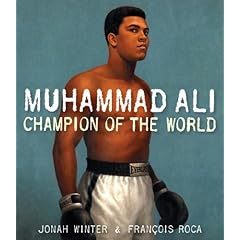
Muhammad Ali Champion of the World


Book Club 2: Muhammad Ali Champion of the World
by Jonah Winter and Francois Roca
Review by Akiko Nagamine

Summary:
Muhammad Ali Champion of the World is a picture book about Ali’s professional boxing career. It is written with a poetic feel, possibly alluding to Ali’s style of speech. It quotes some of Ali’s famous sayings, and uses a unique font to convey a strong message about determination and believing in yourself. The book highlights moments of Muhammad Ali’s professional career, from when he changes his name to when he refuses to fight in the Vietnam War. The book ends with the infamous “Rumble in the Jungle” where Ali defeats George Foreman in Africa.

Reflections:
I chose this book because I wanted to expose my students to a famous African-American who is overlooked in the social studies curriculum. I thought that my students would be interested in hearing Ali’s story because he is a famous person who is not discussed in schools; he is an icon of determination and strength, and some of my students were familiar with his name.

When reading this book to my students, they were extremely sensitive to the racism that was apparent during Ali’s time. Students exclaimed, “That’s racist!” and it evoked some powerful emotions.

How I used the book / Curriculum Units:
I used this book initially as a read aloud to introduce some new vocabulary words to the students. However, since the book conveys such a powerful message, I also used it for accountable talk asking students to critically discuss the major issues in the book. Students were prompted with different note cards that said things like “Muhammad Ali is (or is not) a leader because…” and “Cassius Clay changed his name to Muhammad Ali because ______________. I think that…”

This book can be used to introduce a unit on positive role models and what it means to be a role model in a community. In addition, this book may follow a slavery unit where it can be used to talk about the impact of slavery on future generations of the African-American community. Slavery affected Muhammad Ali, and students can refer to his experience to explore how slavery in this country’s past affects us today.

Portions of this text can be used in a poetry unit, especially because Muhammad Ali was famous for quoting poems to predict the outcome of his fights. He coined some famous quotes that are still used to today, such as “float like a butterfly, sting like a bee”.

Domains of Social Justice:
1. Self Love and Acceptance
– Students will learn that strong faith in themselves will help them accomplish great things. Muhammad Ali continuously believed in himself through the hardest times and was able to become the champion of the world. Students may discuss what a role model is and what it means to be a role model in today’s society.
Students may also engage in a study of Africa, exploring Ali’s strong sense of African pride and connecting that to a study of students’ ancestors.

3. Exploring Issues of Social Justice – Students will discuss aspects of racism Ali faced during his professional career. It will help put into perspective the effects of slavery on people of more recent generations.

4. Social Movements and Social Change - Students will explore Muhammad Ali not only as a boxer but an international humanitarian. He has been an advocate for the world’s hungry, and helped those in need in his home country as well. Students will continue to explore what it means to be a role model, and how they can be an advocate for change as well.

5. Taking Social Action – Continuing in Ali’s footsteps, students will choose a cause that they strongly believe in, or contribute to an organization that Ali is an advocate for. They can do something simple such as volunteering in a soup-kitchen, or contributing to the Muhammad Ali Parkinson Research Center or the Muhammad Ali Boxing Reform Act.

Sunday, March 9, 2008

Mary Braddock

Book Group # 2

Title of the Book: Private and Confidential A Story About Braille

Author: Marion Ripley

Illustrator: Colin Backhouse

Summary: Private and Confidential is a story about a young girl who longs to have a pen pal. When she finally gets one she discovers that her pen pal is visually impaired and that his sister has been reading him all the letters she writes him. The young girl initially becomes very upset about this but she then decides to learn how to write and read Braille so that her and her pen pals can keep their letters private and confidential between the two of them.

Reflections: This is a very simple story, but has an extremely powerful underlying message. The simplicity of the story is engaging though for young students and it’s not just a sappy story about someone who is visually impaired. It can bring up many discussions about a number of different issues, but it especially touches on the topic of how to treat others whom have handicaps or disabilities.

How would I use the book/curriculum units: I recently used this story as a Read Aloud in my student teaching placement in a second grade general education class. I chose it as a read aloud because it was an engaging story and it is a great way to introduce children to the subject if visual impairment. My students loved it. They were extremely attentive and engaged throughout the whole story. Wow! They were also so taken back by the idea of writing and reading in Braille that they asked if I could teach them how to read/write in Braille. Granted this is something I do not know how to do but the back of the book contains some basic to learning how to read Braille so along with my students we learned how to do some reading and writing in Braille. We also then read a book on Louis Braille the inventor of Braille which then led into a geography lesson on France.

After reading the story one of my students mentioned that their grandmother was visually impaired. Another one of my students mentioned that his grandmother was losing her vision and that she often read books on tape so he thought it would be a good idea if some how we could put our published pieces on tape and then send it to her nursing home. I was really impressed with the students’ initiative to think of ways to be more considerate of people having the same opportunities as them. The students discussed how they thought we should do something to ensure that all people are able to read out stories.

Domains of Social Justice: 1) Domains of self-love and acceptance: Students learn to love themselves for who they are. In this case Malcolm who is visually impaired teaches his pen pal that although he has a visually impairment he is still a kid like everyone else and believes he deserve to have the same opportunities to do things like having pen pals like every other kid. He teaches Laura about the cool things he knows like Braille.

2) Respect for Others: In the story the other character Laura learns to appreciate Malcom for Malcom as a person not just by his visual impairment. Students will understand that people are defined by who they are not their disability. Students will learn ways to more considerate of others needs in our everyday world.

3) Exploring Issues of Social Justice: Students can think about how they can make small changes in their everyday world to accommodate those with special needs or disabilities. Students can observe how places that should be public are not accommodating to all people

4) Social Movements and Social Change: Students can make changes in places that are not accommodating to all people or even make changes in their own classroom, school, or community.